
KYC Policy establishes clear identity verification standards for members accessing financial services and account facilities at Pin77 home page. Accurate customer identification supports legitimate account ownership, prevents unauthorized transactions, and maintains consistent compliance procedures. Our verification framework covers personal information, supporting documents, payment ownership, and account activity screening. Each verification stage follows defined review criteria, allowing members to understand the requirements associated with identity approval and continued account access.
Core identity verification standards at Pin77
The KYC Policy establishes the identification requirements applied throughout the customer relationship. Pin77 uses structured verification procedures to connect account records with the individual responsible for financial activity. Personal information, identification documents, and payment ownership details form the primary verification record. These records support account authentication, transaction authorization, and compliance reviews while providing a consistent reference for subsequent changes to customer information.
Under the KYC Policy, customer identification involves collecting sufficient information to establish legal identity and verify document authenticity. Required details include full legal name, date of birth, nationality, residential address, and identification number. Submitted information must correspond with the supporting documents and registered account details. Discrepancies are referred for additional examination before verification status changes, preventing inconsistent identity records from being accepted during account assessment.
The KYC Policy also establishes ongoing verification responsibilities after initial identity approval. Changes involving contact information, payment instruments, residential details, or unusual financial activity can trigger a fresh compliance assessment. Previous verification records remain connected to the customer profile, allowing authorized personnel to examine amendments against earlier submissions. This continuing review process maintains accurate identification records without requiring members to repeat unchanged information during every routine transaction.
Document requirements and customer eligibility
The KYC Policy defines the documentation and eligibility conditions that members must satisfy before receiving verified account status. Our compliance procedures examine document validity, customer identity, and ownership consistency through separate assessment criteria. These requirements apply to personal identification records and supplementary evidence requested during financial verification.
Accepted identification documents and validity checks
Under the KYC Policy, members provide government-issued identification containing a recognizable photograph, legal name, date of birth, and document number. Pin77 examines document completeness, expiration dates, and consistency with account records. Identity evidence is classified according to its issuing authority and available authentication features. The principal accepted document categories include:
- Passport: Valid identification with a photograph and nationality details.
- Philippine national ID: Identification containing registered personal information.
- Driver’s license: Current government-issued photographic identification.
- UMID card: Identification issued under applicable Philippine government programs.
Eligibility screening and account ownership assessment
The KYC Policy requires each verified customer to satisfy applicable legal-age and account ownership requirements. Our compliance team examines declared identity details, identification records, and any restrictions identified during screening. Verification also establishes whether the applicant controls the submitted account information and associated payment methods. The assessment covers duplicate identity records, inconsistent personal details, and third-party account usage, with unresolved discrepancies preventing completion of the approval process.
Verification procedures and compliance control measures work
The KYC Policy organizes customer verification into documented assessment stages, allowing our compliance personnel to examine identity evidence and financial ownership records consistently. Each stage produces a review outcome that determines whether the submitted information satisfies the applicable requirements. Additional examination applies when records contain discrepancies or require further authentication.
Identity authentication and document examination
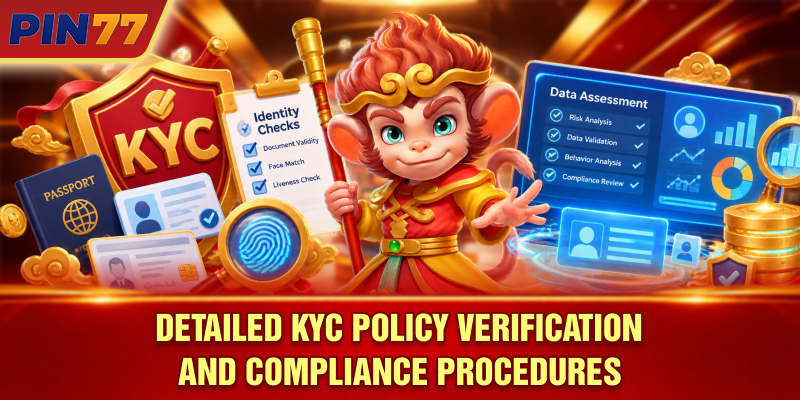
The KYC Policy uses identity matching and document examination to establish whether submitted evidence corresponds with the registered customer. Pin77 reviews visible identification details, document integrity, and the relationship between the photograph and account holder. Where enhanced authentication is required, facial comparison or supplementary identification may form part of the assessment. The review also checks document expiration, altered information, incomplete images, and inconsistent personal records before assigning an approval outcome.
Verification status categories and review outcomes
The KYC Policy separates verification outcomes into distinct administrative categories, allowing customer records to reflect their current compliance position. Our review framework distinguishes complete submissions from records requiring additional evidence or correction. The following table illustrates a structured verification-status model and its associated administrative treatment.
| Verification status | Assessment condition | Administrative action |
| Pending | Initial identity documents and address records have been successfully uploaded and placed into the compliance queue. | Hold the request in the processing queue and maintain temporary account limits until examination begins. |
| Under review | Automated checks and manual authentication are actively cross-referencing government IDs and residential records against official databases. | Examine all submitted evidence for authenticity, expiration validity, and consistency with the registered account profile details. |
| Verified | All Know Your Customer, Anti-Money Laundering, and age verification requirements have been completely satisfied and confirmed. | Confirm full identity approval, update the user compliance tier, and lift all provisional account access restrictions. |
| Restricted | Material discrepancies, unverified funding sources, or compliance risk triggers have been identified during routine account screening. | Immediately limit affected account functions, freeze outbound withdrawals, and cap deposits pending a formal risk investigation. |
| Rejected | Submitted evidence fails core authenticity checks, indicates altered documentation, or violates jurisdictional and minimum age requirements. | Formally decline the verification request, revoke transactional privileges, and initiate standard account closure protocols immediately. |
Status classification under the KYC Policy provides a clear record of each compliance decision. Review personnel document the assessment outcome and identify the evidence supporting approval, restriction, or rejection. Members receive the applicable status notification through the designated account communication channel, while subsequent document submissions are examined against the existing verification record.
Payment verification
The KYC Policy extends identity examination to payment ownership and transactions requiring enhanced due diligence. Financial records are assessed against the verified customer profile, with additional documentation requested where ownership or transaction purpose requires clarification. Relevant examination categories include:
- Bank ownership: Account-holder name and supporting bank records.
- E-wallet verification: Registered ownership details for GCash or Maya.
- Transaction evidence: Payment references and supporting receipts.
- Enhanced review: Additional identity or source-of-funds documentation.
These checks allow the KYC Policy to distinguish authorized financial activity from transactions involving inconsistent ownership information. Enhanced examination may include reviewing the origin of funds, the relationship between accounts, and relevant transaction documentation. Our compliance personnel record the outcome before deciding whether the affected transaction can proceed or requires further investigation.
Data protection, ongoing regulatory compliance requirements
The KYC Policy governs how identification information is retained, accessed, corrected, and examined during continuing compliance reviews. Pin77 applies documented handling procedures to customer records, including restrictions on unauthorized disclosure and access unrelated to verification duties. The principal operational controls cover the following areas:
- Confidential records: Identity documents and personal details are maintained within restricted customer files.
- Access permissions: Authorized compliance personnel receive access according to assigned responsibilities.
- Information correction: Updated personal details are examined against supporting identification evidence.
- Periodic screening: Customer records undergo additional examination when relevant risk indicators arise.
- Transaction monitoring: Financial activity is reviewed for ownership inconsistencies and suspicious patterns.
- Compliance escalation: Material discrepancies are referred for further assessment and documented resolution.
- Account restrictions: Relevant financial functions may remain unavailable while essential identity issues are unresolved.
Conclusion
KYC Policy provides the administrative framework for maintaining accurate customer identities, accountable financial transactions, and consistent compliance decisions at Pin77. Its value extends beyond initial document approval through structured record maintenance, enhanced due diligence, and controlled access to sensitive information. Clear verification outcomes and documented review responsibilities support dependable account administration while preserving the integrity of customer identification throughout the account relationship.